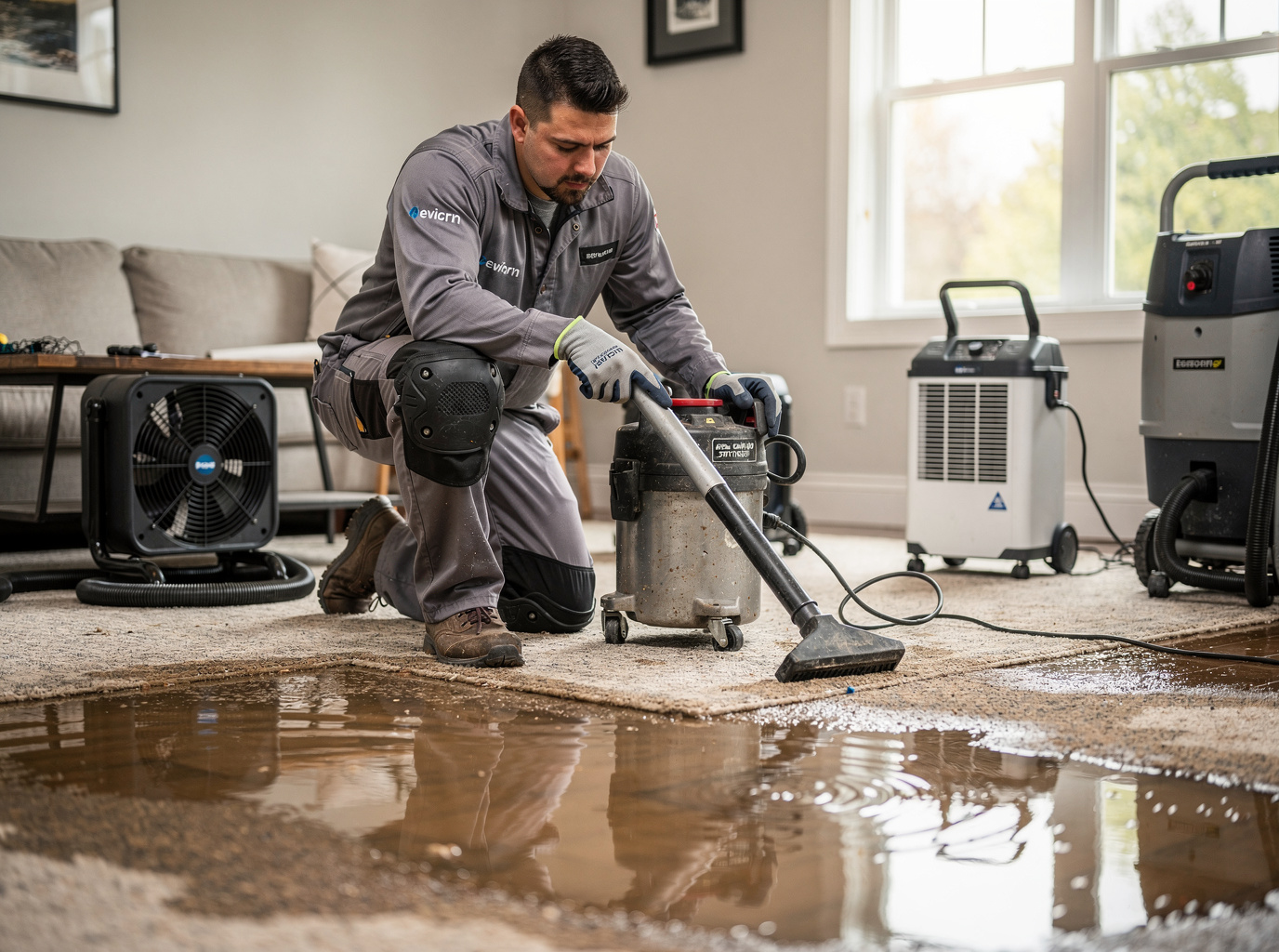
Arlington's humid subtropical climate brings heavy summer downpours that quickly saturate crawl spaces and slab foundations common in North Arlington and East Arlington neighborhoods. Older wood-frame houses near the University of Texas at Arlington often have limited access points, so technicians must pull baseboards and drill weep holes to reach trapped moisture before it migrates to adjacent rooms. Mild winters keep soil saturated longer, increasing hydrostatic pressure against foundations in South Arlington.
Tarrant County building practices from the 1970s and 1980s left many homes with particleboard subfloors and unsealed ductwork in attics. When a supply line bursts near Globe Life Field or AT&T Stadium, water travels along HVAC lines and soaks insulation over finished ceilings. Restoration crews cut and remove affected drywall in 2-foot sections above the water line, then use moisture meters to confirm readings below 15 percent before reinstalling.
Homes in Mansfield and Grand Prairie border areas frequently experience runoff from Six Flags Over Texas parking lots during intense storms. Technicians stage air movers in a herringbone pattern across hardwood floors to pull moisture from the tongue-and-groove edges without cupping the boards. Dehumidifiers sized at 70 pints per day run continuously for 48 to 72 hours until equilibrium is reached with outdoor humidity levels.
Repair work in Downtown Arlington often involves multi-story commercial conversions where water travels through elevator shafts and shared walls. Crews isolate zones with plastic sheeting, document affected square footage for insurance adjusters, and coordinate with licensed plumbers to replace failed shut-off valves before final reconstruction begins.
Technician insight
In Arlington the thing that catches most people out with Water Damage Repair is how quickly moisture travels under the slab in East Arlington homes built on clay soil; one summer storm can push water 15 feet laterally before anyone notices the baseboards buckling.
Ceiling Leak After Heavy Rain
Water from a clogged gutter on a South Arlington duplex traveled along ceiling joists into the living room. Inspection showed saturated blown-in insulation and wet drywall above the light fixtures. Crews removed the wet materials, dried the cavity with directed airflow, and reinstalled matching texture and paint.
Water Damage Repair Services We Offer
✓Emergency Water Extraction
Rapid removal of standing water from slabs and crawl spaces in North Arlington homes using truck-mounted pumps to limit secondary damage to subfloors.
✓Structural Drying and Dehumidification
Placement of commercial air movers and dehumidifiers to dry wall cavities and attic insulation after roof leaks near AT&T Stadium.
✓Drywall and Insulation Removal
Selective demolition of water-saturated drywall and fiberglass batts in East Arlington residences to prevent hidden mold growth.
✓Hardwood Floor Restoration
Sanding and refinishing cupped hardwood floors in South Arlington properties after appliance leaks while preserving original trim profiles.
✓Carpet and Pad Replacement
Disposal of saturated carpet and padding followed by antimicrobial treatment of concrete slabs common in 1980s Tarrant County construction.
✓Crawl Space Moisture Control
Installation of vapor barriers and sump pumps in older Arlington homes to manage seasonal humidity from mild winters.
Water Damage Repair Cost in Arlington, TX
| Service | Typical Range | What Affects It |
|---|---|---|
| Initial Assessment and Extraction | $250–$600 | Varies with volume of water and access in older North Arlington homes |
| Drying Equipment Rental | $150–$400 per day | Number of air movers and dehumidifiers required after summer storms |
| Drywall and Insulation Replacement | $800–$2,200 | Linear feet affected and whether ceilings or multiple walls are involved |
| Hardwood Floor Repair | $1,200–$3,500 | Square footage and whether sanding or full board replacement is needed |
Ranges are typical for Arlington, TX and confirmed with an exact written quote before any work starts.
How it works
- 1
On-Site Assessment
Technician arrives from the 1216 W Arkansas Ln location and maps moisture with thermal imaging across affected rooms.
- 2
Water Removal
Standing water is extracted and contents are relocated before demolition begins.
- 3
Drying Phase
Equipment runs until moisture readings meet industry standards for Arlington's humidity levels.
- 4
Repair and Reconstruction
New materials are installed and finishes matched to pre-loss condition.
Pricing
Most Arlington water damage repair jobs fall between a few hundred and several thousand dollars depending on affected square footage and hidden damage.